
The MVP: Its Definition And Use
If you are in the tech world, you are probably familiar with the acronym MVP. For Quebecers born in the 90s, of course, we are not referring to “Mon vaillant primate”! It is rather the “Minimum Viable Product.”
You can see an MVP as the simplest expression of a product. We want it functional, but fairly less automated or aesthetic. An MVP therefore renders the final promise of the product, simply in a less sophisticated way.
Its primary purpose is to test the market. It allows, first and foremost, to confirm whether the product meets a real need, whether it is marketable or not, and, if so, the cost that users will be willing to pay for the finished product.
In a figurative way, an MVP is this:
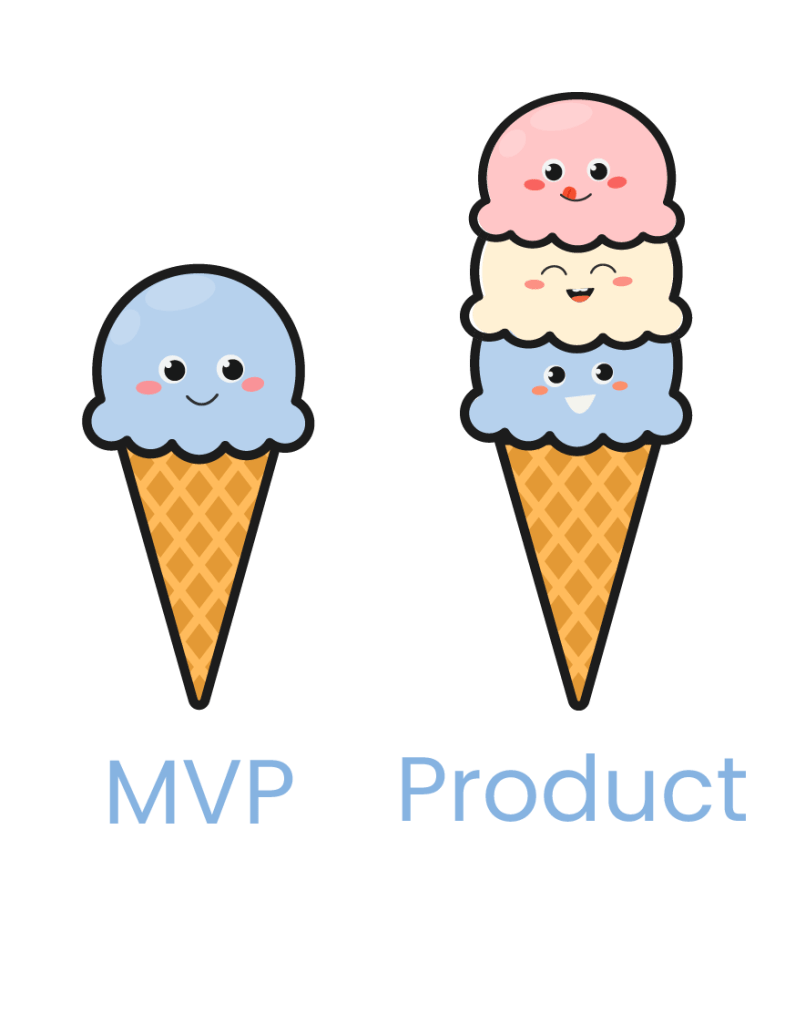
However, we must mention an important element: before reaching this stage, it is essential to carry out a market analysis. It would be a colossal mistake to go into programming an MVP without understanding their target audience. At TLM, we create the MVP when our customer’s business plan is clearly defined and he knows the needs and characteristics of his future client base.
THE CREATION OF A MVP
When programming an MVP for a customer, we make sure to meet the real needs of their users. Therefore, it is necessary to go through a creative process. It allows us to create the right level of quality to test the product at minimum cost.
Define the target customer’s fundamental need

Define how the product will solve the need
Determine the process to be built to resolve the need. Steps and essential features

Determine which feature groups provide the most value and programming them as a priority

Test the MVP and then launch it to the target customer

Repeat steps 2-5 until the MVP actually responds to the needs. Then start the finished product’s programming

In general, here are the steps for creating an MVP at TLM :
- Define the basic need(s) of the target clientele. Which is priority? Are they aligned with the entrepreneur's business goals?
- Define how the product will solve the need(s)!
- Determine the process to be built to solve the need(s). What steps do we have to go through? Which features are essential to gain user buy-in?
- Determine which feature groups provide the most value and schedule them first.
- Test the MVP then launch it with the target customers and get feedback.
- Repeat steps 2 to 5 until the MVP really meets the needs. Then, start programming the finished product.
Producing an MVP does not happen overnight. This requires in-depth reflection on the essential needs of future users. It is imperative to understand which features have the most value for potential customers. These are the features that we will develop first.
When creating an MVP, some people prefer to code a bit of each feature. For them, it is necessary to program them all minimally to achieve sales success. At TLM, this is not our way of doing things. Instead, we think about the features that have the most value for the user. We develop them all to the detriment of others. Those that have been set aside will be developed in a second step for the launch of the finished product, all in a predefined order with the entrepreneur. The difference between the two may seem trivial, but believe us, it can have a big influence on the appreciation that a user will have.
In short, we seek to create maximum value for the user, while investing a minimum of time and money. This is why an MVP is so crucial in the development of a software product or an application: you have to plan the work to be done by prioritizing the right features.
THE CHALLENGE OF CREATING AN MVP

Creating an MVP means challenging each other, but also challenging the wishes of the entrepreneur in front of us. A concrete example: with one of our customers, we chose not to automate a data processing function. Deploying this feature required significant IT development (therefore an additional monetary investment for it). As for him, the manual sorting did not require a lot of time or effort. The cost versus the benefits was therefore not worth it.
It should also be understood that the time and monetary investment required to create an MVP varies from project to project. The reason is very simple: one may require very simple functionality while the other may require more complex development. We always come back to the basic question: what are the features that have the most added value for the future user?
THE BENEFITS OF CREATING AN MVP
The MVP will allow you first and foremost to test your software product. You will thus know the perceived value of your solution by your users. You will be able to see customer response and get recommendations for improvement in order to create your final product. You’d be surprised at the answers you’ll get! It is not uncommon for a functionality that seems fundamental for the entrepreneur not to be so for his or her potential client. We learn a lot by probing the field in this way.
Also, depending on your sales success, you will be able to assess whether you are financially able to continue programming.
Overall, the MVP is:
- A test version of your software product including limited, but essential functionality!
- A good way to develop your product while marketing the features developed to date.
- A tool to validate the interest of your target customers.
- A way to identify market needs and predict the evolution of your product.
- An efficient way to finance the development of your final product.
In short, the development of an MVP requires a great knowledge of your target customers and programming expertise. That’s why teaming up with experts in software creation is, in our opinion, the best option for you if you want to set up a new tech product.
You can always start programming yourself in order to advance your product before doing business with an external team. Nevertheless, we strongly recommend that you surround yourself well to develop your MVP. The sooner this team is involved in the project, the better it will be for your business!
If you are about to create your MVP, write to us. We can discuss it over a good coffee, virtual or not!